Straight answers to the questions we're asked most often by brands evaluating us for OEM, private label, and custom candle manufacturing — organized by topic for easy scanning.
Don't see your question here? Get in touch and we'll answer it directly.
Manufacturing
Can you provide OEM, private label, or custom candle manufacturing?
Yes — OEM, private label, and custom candle manufacturing are our core business. Whether you have a complete product concept or just an initial idea, our R&D team works with you to develop a candle that matches your brand vision. Customization covers vessel design, wax formulation, fragrance, wick, decoration, lid, packaging, and labeling.
What waxes do you work with?
We work with soy wax, coconut wax and coconut blends, paraffin wax, beeswax, and custom blends. Our technical team recommends the right wax based on your fragrance performance, burn characteristics, positioning, and budget. See our wax comparison guide.
Do you provide sample development before bulk production?
Yes. Every project starts with a sample development stage. We share physical samples matched to your brief, incorporate revisions, and only begin bulk production after you approve the final sample. This is included in the project workflow.
What is your production lead time?
For standard customized products with approved samples, production typically runs 4–6 weeks from PO to ex-works. Projects requiring new molds or extensive customization may need additional time, which we communicate upfront before the project begins.
Can you produce candles at scale?
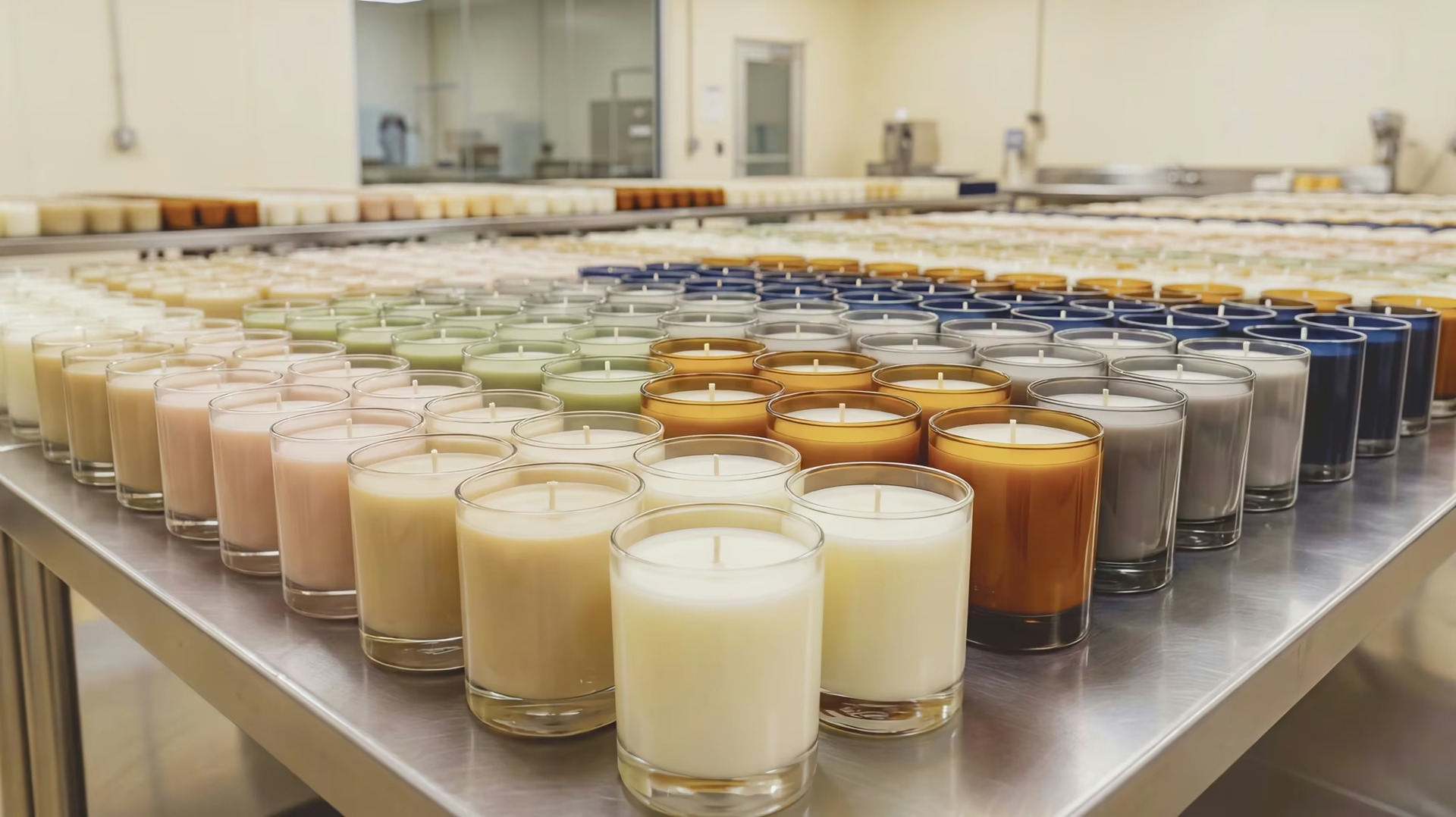
Yes. Our facility is set up for both pilot runs (500–2,000 units) and volume production (up to 25,000+ units per SKU per run). Larger scheduled programs are welcome — we plan capacity ahead of time for confirmed forecasts.
What's the difference between OEM, private label, and white label candle manufacturing?
They sit on a spectrum of how much you design versus how much you buy off-the-shelf. OEM (Original Equipment Manufacturing) means we build a candle to your exact specification — your formulation brief, your vessel choice, your fragrance direction. Private label means we develop the product collaboratively with you and it ships under your brand only, with no Wickbond branding. White label means you select from an existing, already-developed formulation or vessel and simply apply your own branding and packaging — the fastest route to market. Most brands that start with white label move to full private label as they scale.
Can you manufacture under our own brand with zero Wickbond branding anywhere?
Yes. Every private label, white label, OEM, and contract manufacturing program ships under your brand only — no Wickbond markings on the vessel, lid, label, packaging, or shipping cartons unless you specifically want a "manufactured by" credit for compliance reasons in your destination market.
Do you offer contract pouring if we already have our own formulation and vessel?
Yes — that's exactly what our contract pouring service is for. If your formulation, fragrance ratios, and vessel are already locked (from your own R&D or a previous supplier), we execute production to your exact specification without a full development cycle, which shortens lead time and lowers development cost. See our Contract Pouring page.
What's included in a typical private label manufacturing program?
A full private label program typically includes: formulation and fragrance development, vessel sourcing or mold development, sample rounds with revisions, packaging and label design support, compliance documentation (SDS, IFRA, batch QC), production scheduling, and export-ready packing. You can also add optional services like product photography once the final product is approved.
Can you handle multi-SKU product lines (e.g. a 6-scent collection) in one program?
Yes. Multi-SKU collections are common — a shared vessel and packaging system across several fragrance variants, or a fully differentiated range per SKU. We plan raw material intake and production scheduling around the full collection so all SKUs are ready to ship together.
MOQ & Pricing
What is your minimum order quantity (MOQ)?
We don't enforce a fixed platform MOQ. For product development we can support single-sample and pilot runs (500–2,000 units), and for scaled production most SKUs run at 3,000–10,000 units. Custom vessels or exclusive fragrance IP typically raise MOQ to 5,000–10,000 units. See our MOQ deep-dive.
How much does a private label candle cost to manufacture?
Ex-works cost typically ranges ₹120–₹450 per candle (approx US $1.45–$5.50) depending on wax type, vessel, fragrance load, and packaging complexity. Freight and duties add another 12–22% at landed cost. Read our candle pricing guide for a full breakdown.
Do you charge development or tooling costs?
Custom molds (glass or ceramic), printing plates, packaging dies, artwork setup, and physical sampling involve one-time development costs specific to your project. We share a transparent breakdown before starting. Development costs are often adjustable against bulk orders once you scale.
Are prices firm, or do they change with volume?
Prices scale with volume. Pilot runs (500–2,000 units) carry a per-unit premium. Volume production (5,000+ units) drops per-unit cost meaningfully — typically 15–25%. We provide tiered pricing so you can plan reorder economics.
What payment terms do you offer?
Standard terms are 50% advance on PO confirmation and 50% before dispatch. For repeat clients with a track record, we can discuss modified terms. All invoices are issued in USD or INR based on your preference.
Does MOQ differ between soy, coconut, and paraffin wax?
Not significantly for the wax itself — MOQ is driven mainly by vessel tooling and fragrance sourcing, not wax type. Soy and coconut blends are our most commonly ordered waxes at standard MOQ tiers; paraffin and beeswax can be ordered at the same tiers, subject to fragrance and vessel compatibility testing.
Is there a minimum order value in addition to a unit MOQ?
We work primarily to a unit MOQ rather than a fixed minimum order value, since per-unit cost varies a lot by vessel and packaging complexity. In practice, our standard pilot and production tiers land within typical B2B order-value ranges — we'll confirm the total for your specific product during quoting.
Can we start with a smaller pilot order and scale up later?
Yes — this is the most common path for new brands. Start with a pilot run (500–2,000 units) to validate the market, then scale into standard volume production (3,000–10,000+ units per SKU) once you have sales traction, without re-doing development work already completed.
Do you offer volume-based discounts on repeat orders?
Yes. Repeat and forecast-based orders typically see meaningful per-unit savings over pilot-run pricing, and reorders don't carry development or tooling costs a second time since molds, artwork, and formulations are already finalized.
What currency do you quote in?
We quote in USD or INR based on your preference, and invoice accordingly. For international buyers, USD is the default and most common currency.
Customization
Can you develop a custom vessel for our brand?
Yes. We develop fully custom candle vessels in glass, ceramic, concrete, metal, wood, and acrylic. We can create a new mold from your design brief or customize an existing profile. Custom vessels involve upfront tooling and typically higher MOQ (5,000+ units).
Can you develop our own fragrance formulation?
Yes. We work with IFRA 51 compliant fragrance oils sourced from European fragrance houses. We can develop a custom fragrance from a brief, adapt an existing accord, or use an oil you supply directly (subject to compatibility testing in our wax).
Can you handle luxury packaging?
Yes. We source and print luxury rigid boxes, folding cartons, sleeves, custom labels, ribbons, wax seals, and molded pulp inserts. See our packaging guide for material options.
Do you offer decorative candles — dried flowers, crystals, etc.?
Yes. Our decorative capability includes dried florals, crystals, gemstones, embedded decoration, layered pours, marble effects, and premium finishes. Decorative elements are added post-pour and are QC'd for burn safety.
Can you print our logo on candles or lids?
Yes — logo printing, embossing, engraving, foil stamping, and label application are all standard. For lids we work with wood, metal, and bamboo with laser engraving or pad printing.
What decoration or finish options are available on the vessel?
Vessel finishes include frosted glass, colored glass, matte or gloss ceramic, painted concrete, textured surfaces, gold/silver rim application, sandblast logos, and decal transfers.
Can we supply our own fragrance oil?
Yes, subject to a compatibility test in our production wax first — fragrance oils behave differently across soy, coconut, and paraffin bases, so we test scent throw, discoloration, and burn behavior before committing to bulk production with a customer-supplied oil.
Is there a minimum order for fully custom molded vessels?
Yes — new mold development (glass, ceramic, or concrete) typically requires a higher MOQ, usually 5,000+ units, to offset the one-time tooling investment. Customizing an existing mold profile (e.g. adding a logo emboss to a vessel we already produce) can be done at lower volumes.
Can you match a Pantone or specific color for wax, labels, or packaging?
Yes. We color-match wax tints, printed labels, and packaging materials to Pantone references wherever the substrate allows, and confirm the closest achievable match with a physical sample before bulk production.
Do you offer multi-wick candle configurations?
Yes — double and triple-wick configurations are available for larger vessel formats, sized and centered according to vessel diameter and wax type to ensure an even melt pool.
Can you create a signature/proprietary scent exclusive to our brand?
Yes. Exclusive fragrance development is available — we formulate a scent specific to your brief and can restrict its use to your brand only as part of the development agreement, typically alongside a Mutual NDA.
Compliance & Quality
What quality certifications and documentation do you provide?
Every shipment includes an SDS (Safety Data Sheet), IFRA compliance certificate for the fragrance oil used, and a batch-level QC release document. We support additional documentation formats when required for specific retailers or destination countries. See our Quality Assurance page.
What are your quality control procedures?
QC operates across four stages: raw material intake (wax, fragrance, wicks, vessels are lot-tested), in-process checks (pour temperature, wick centering, fragrance dosing), cured-batch burn testing (melt pool, scent throw, soot), and final packing inspection. Statistical burn samples are taken from every batch before release.
Do your candles meet international safety standards?
Yes. We follow ASTM F2417 for candle safety, EN 15493/15494 for European markets, IFRA 51 for fragrance safety, and CPSC/CLP for consumer-safety labeling. See our Safety Standards page.
Can you support ISO or third-party audits?
Yes. We can host third-party audits at our facility (with reasonable advance notice) and can support factory audits by SGS, Intertek, or your own quality team. Documentation and process traceability are maintained for every production run.
Do you sign a Mutual NDA before receiving design details?
Yes. We're happy to execute a Mutual Non-Disclosure Agreement (NDA) before receiving proprietary designs, formulations, or IP. Confidentiality is fundamental to how we work — see our Global Trade Confidentiality Charter.
Do you test for phthalates and other restricted substances?
Yes. Fragrance oils are sourced IFRA 51 compliant, which restricts phthalates and other regulated substances, and batch documentation confirms compliance for the destination market's requirements.
Can you provide REACH compliance for the EU market?
Yes. REACH declarations are available for EU-bound shipments as part of the standard export documentation folder, alongside SDS and IFRA paperwork.
What happens if a batch fails quality control?
A batch that doesn't meet burn testing, scent throw, or visual/finish standards at any QC checkpoint is held and not released for packing or shipment. We investigate root cause (raw material, process, or environmental) before re-running the affected batch.
Do you retain samples from each production batch?
Yes. Retained batch samples are kept for traceability and can be referenced if a quality question arises after shipment.
Are your fragrance oils vegan and cruelty-free?
Our standard fragrance oil sourcing is synthetic/nature-identical and not animal-tested. If your brand requires a certified vegan or cruelty-free claim on packaging, let us know during development so we can confirm sourcing meets that specific certification standard.
Shipping & Export
Which countries do you export to?
We regularly ship to the United States, Canada, United Kingdom, France, Italy, Germany, Sweden, UAE, Saudi Arabia, and Australia — among others. Our documentation and packaging are set up for export from day one.
How do you ship candles internationally?
For pilot orders, we typically use airfreight (4–7 day transit). For volume orders, sea freight is standard — either LCL or FCL depending on carton count. We coordinate with your freight forwarder, or can suggest partners we've worked with before. Read our export shipping guide.
Do candles need special shipping precautions?
Yes. Wax melt points around 50–65°C mean candles shipped through hot lanes (Middle East, equator crossings in summer) need climate-controlled containers. We advise on this per lane and season during shipment planning.
What documentation ships with the goods?
A standard export folder includes: commercial invoice, packing list, Certificate of Origin, SDS per SKU, IFRA compliance certificate, and QC batch release document. For EU shipments we also provide REACH declarations. For GCC we support ESMA/SASO conformity paperwork.
Are your labels compliant with US CPSC / EU CLP / GCC ESMA regulations?
We can produce labels that comply with the destination market's regulations — including hazard pictograms and warning statements for CLP, ASTM F2417 warning text for CPSC, and Arabic-language labels for GCC. Compliance details are confirmed as part of artwork sign-off.
Who handles customs clearance at the destination?
Destination customs clearance is typically handled by your freight forwarder or customs broker at the receiving end. We provide the full export documentation set (commercial invoice, packing list, Certificate of Origin, SDS, IFRA certificate) needed for smooth clearance.
Can you ship directly to Amazon FBA or a 3PL warehouse?
Yes. We can pack and label to FBA or 3PL-specific requirements (carton labeling, unit barcoding, pallet configuration) — share your warehouse's inbound guidelines during the packaging planning stage.
What Incoterms do you work with (FOB, CIF, EXW)?
We commonly quote EXW and FOB (from an Indian port), and can arrange CIF or DDP through our freight partners if you'd prefer landed pricing to your destination port or address.
How are candles packed to prevent damage in transit?
Individual vessels are cushioned (typically molded pulp or corrugated dividers), cartons are sized to minimize void space, and cartons are palletized and shrink-wrapped for ocean/air freight. Climate-controlled containers are used for hot shipping lanes given wax's ~50–65°C melt point.
Do you provide tracking once goods are shipped?
Yes — once cargo is handed to the freight forwarder, we share the shipping line/airway bill and tracking reference so you can monitor transit alongside your forwarder.
Samples
How do I request a sample pack?
Order directly through our Sample Pack page — it's a fixed $99, shipped worldwide, and checkout is handled securely via PayPal.
What's included in the $99 sample pack?
Three wax and fragrance combinations (soy, coconut blend, and paraffin) so you can compare burn quality, scent throw, and finish before committing to a pilot or production order. Full details are on the Sample Pack page.
Is the sample pack cost credited toward my first order?
Yes — the $99 sample pack cost is credited toward your first pilot or production order once you move forward.
How long does sample pack shipping take?
International sample shipments typically arrive within 7–14 business days depending on destination, using tracked courier service.
Can I request samples of a specific wax or fragrance combination outside the standard pack?
Yes — once we're in active project discussion, we can prepare project-specific samples matched to your brief in addition to (or instead of) the standard $99 pack.
Do you offer free samples?
The standard sample pack is $99 to cover material and worldwide shipping cost, and that amount is credited to your first order — so for brands that move forward, it's effectively free. We don't offer no-cost samples with no order intent, to keep sample quality and turnaround consistent for serious evaluations.
Business Setup
How do I start working with Wickbond?
Submit your product concept, target volume, and timeline through our quote request form. We'll follow up within 2–3 business days with feasibility, initial pricing bands, and suggested next steps — including a video meeting if useful.
Do you offer a video meeting during evaluation?
Yes. Once both parties agree to proceed with evaluation, we schedule a video meeting to review product concepts, customization options, development timeline, and any technical or commercial questions.
Do you offer sustainable / eco-friendly options?
Yes — natural soy and coconut wax blends, cotton or wood wicks, FSC-certified paper packaging, molded pulp inserts, refillable vessel formats, and biodegradable outer cartons. See our eco-packaging guide.
Do you offer product photography or videography?
Yes — optional professional product photography and lifestyle videography can be arranged once the finalized product is approved. These are billed separately as optional add-ons.
Do you work with startups or only established brands?
Both. We've onboarded first-time founders launching their first candle range, as well as established retailers and hospitality groups scaling volume programs. Our low-MOQ pilot pathway is specifically designed for new brands validating their market.
Can we visit the Wickbond facility?
Yes. Facility visits are welcome after an initial screening call and NDA. Kanpur is well-connected by air (Lucknow airport is ~1 hour away). We arrange a full walkthrough of the production line, R&D lab, and QC processes.
Do you work with distributors and wholesalers, or only direct brands?
Both. We manufacture for direct-to-consumer brands, retailers, hospitality groups, and distributors/wholesalers building out a candle assortment — MOQ and program structure adjust to your business model.
Can you support a hospitality or hotel amenity candle program?
Yes. Hospitality and hotel amenity programs typically involve a signature scent, branded vessel, and recurring reorder schedule — a good fit for our volume production tiers and repeat-order pricing.
What information should I include in my first inquiry?
Your product concept (or reference examples), target volume, target markets, and rough timeline are the most useful starting details. The more specific you can be, the faster we can return accurate feasibility and pricing.
Do you require an exclusivity agreement?
No, exclusivity isn't required by default. If your program depends on a proprietary formulation, vessel, or fragrance staying exclusive to your brand, that can be written into the project agreement alongside the Mutual NDA.
Still Have Questions?
Talk to Our Team
Every project starts with a short feasibility conversation — no fixed MOQ required.